








Talent Acquisition’s advertising space has been transformed more than any other work function. Talent Acquisition for years has always been about posting jobs, reviewing hundreds of resumes, and using human intuition to determine whether a candidate would be successful in their role. Today Talent Acquisition is nothing like it was and the future of recruiting is changing.
With the use of AI the future of technical recruiting is no longer just improving archaic processes, but it is also creating entirely new workflows and opportunities, forcing Talent Acquisition professionals to reinvent themselves as more than just administrative coordinators, but rather strategic partners in the talent acquisition process. This change to the world of recruiting represents a paradigm shift to the way organizations discover and connect with, and on-board their most important resource; their People.
In this document, we will cover the key technologies that are changing the way Talent Acquisition is done, the strategic advantages of these technologies, and the ethical challenges that all talent leaders will have to deal with as part of their role.
Table of Contents
The Rise of Intelligent Recruiting: Why AI Is Changing the Game
As AI technology powered by Machine Learning (ML) has transformed from an option to a necessity in a highly competitive environment for the future of recruiting and retaining employees, AI also changes the recruitment process in three major aspects (volume, speed and bias reduction) for hiring managers who recruit for large numbers of people.
Due to the shortages of qualified workers around the world, hiring managers will be unable to use manual means to recruit and maintain those on their staff because the volume of applications received by the hiring manager will greatly exceed their capacity to process these applications. An AI-enabled technology has been capable of rapidly processing very large amounts of applicant data, including resumes, interview transcripts, and performance records, almost instantly, allowing recruitment teams to compile information that would take them weeks to gather and analyze.
This increased speed allows hiring managers to reduce time-to-hire from weeks to days, which is critical in securing top talent. AI algorithms, when configured correctly, will allow for unbiased determinations of suitability for employment based on objective and level of skill. AI offers a potential way to eliminate some of the bias inherent in human decisions.
AI has given organizations the ability to define the qualities of excellent job performance and capabilities required for success based on actual historical data. Because of this, recruitment decisions can now be based on this data rather than relying solely on the intuition of human managers.
From Resumes to Algorithms: How Automation Streamlines Candidate Screening
The automation of repetitive tasks in recruiting through AI will have the quickest and most extensive impact. The use of AI to automate manual resume screening has a long history of taking up the time of recruiters and introducing subjectivity into the hiring decision-making process.
With the use of Natural Language Processing (NLP) and other advanced technologies, today’s Recruitment Automation Tools are capable of automatically reading resumes and then categorizing and ranking them based on the specific criteria defined by the Job Description in addition to the records of the company’s past performance history in hiring for that position/skill set.
The application of Algorithms to solve the problem of initial funnel management is what AI will offer in recruiting today. Rather than simply filtering based on keywords, AI will also evaluate the contextual relevance of a candidate’s experience and will give priority to candidates that have core competencies versus those that simply created keyword optimized documents for the purpose of being selected by the Algorithm.
The use of AI to automate the repetitive tasks of recruiting allows recruiters to focus on building candidate relationships and the assessment process that occurs in the final stage of the recruitment process.
Read More: How to extract data from linkedin using api?
Leveraging AI for Data Extraction and Candidate Insights: The Role of Tools like Magical API
Recruiters acquire and synthesize candidate information on a regular basis to successfully find candidates for open positions. Historically, the method for collecting information required recruiters to manually review resumes and profiles; however, today, niche API applications have been created that can effectively convert unstructured data into actionable insight.
An example of this type of application is the Magical API platform, which is one such instance of a developing trend of providing developer-centric tools with an AI advantage in providing career and data information to organizations wishing to build out their data pipelines.
The Magical API platform includes multiple capabilities, but one feature that stands out is its ability to act as an advanced Resume Parser, or parsing software. The Advanced Resume Parser is more than just software for keyword recognition, but instead utilizes a structural method to parse resumes and standardize the candidate’s education and work experience into clean, usable data fields that can easily be imported into an Applicant Tracking System (ATS) without having to do additional work on the part of the recruiter.
Additionally, the platform utilizes readily accessible professional data through capabilities such as a Linkedin Profile Scraper and Linkedin Company Scraper. These tools can accurately and efficiently collect structured information from public profiles and company page posts enabling recruiters and talent intelligence teams to build out their own databases, track talent movement, create a Map of competitor organisation structure and provide detailed market intelligence.
By leveraging this type of data-driven methodology organisations are able to pro-actively Source and Market Conditions which will radically change how they now approach Talent Strategy. By creating structured records from previously unstructured data points, these products will streamline the sourcing Timeline and also ensure Data Accuracy which is needed for Fair & Effective AI Screening.
LinkedIn Company Scraper - Company Data
Discover everything you need to know about LinkedIn Company Scraper , including its features, benefits, and the various options available to streamline data extraction for your business needs.
The Shift to Skills-Based Hiring: How AI Decodes Potential Over Credentials
Recruiting has undergone a substantial shift in recent years due to the implementation of Artificial Intelligence into recruiting processes. The focus of many companies has transitioned from strictly requiring specific degrees and years of experience, to determining the skill sets and competencies of their applicants that can be verified through testing and assessment methods.
This shift is paramount as it allows for much greater access to a variety of candidates from different backgrounds and will aid in closing many of the skill gaps that are currently widening throughout the industry.
Artificial Intelligence is playing a pivotal role in driving this change. AI algorithms are not only trained on candidate educational information, they also leverage machine learning to create a “map” to match a candidate’s project experience, certification, and demonstrated ability against the skill requirements for any given position.
AI powered skills assessments create “job simulations” and allow companies to assess candidates’ inherent potentials rather than their accumulated experience. For example, a company may evaluate an applicant’s performance on a coding exam, or an interview simulation based upon scenario-based questions. By eliminating traditional barriers to entry for candidates, this approach is enabling many companies to identify high-quality candidates who may not have followed the conventional path to success, yet can still demonstrate possession of requisite skills to meet the needs of their employers.
Predictive Analytics and Hiring: Turning Data into Better Decisions
AI can be utilized in predicting future outcomes. Through predictive analysis, historical data (time to productivity, source of hire, internal performance reviews, retention rates) are used to create models that will allow an employer to predict the success or longevity of an employee in a certain role and within an organisation’s culture.
Models created using predictive analytics provide data-driven information for hiring decisions throughout the recruiting process. Predictive analysis allows an employer to identify which sourcing methods are most successful and enables managers to shift budget to more effective sourcing methods.
Predictive analysis also can help identify candidates who possess traits most likely associated with high performance and long-term retention. By providing hiring managers and recruiters with a probability score instead of just a ranking, predictive analytics allows the future of recruiting process to become more proactive and allows hiring managers and recruiters to make data-driven, strategic hiring decisions.
The Human–AI Partnership: Balancing Efficiency with Empathy in Recruitment
AI is a much more powerful co-pilot for recruiters than a replacement. Automation will handle the transactional part of the work like data entry, screening and scheduling. This will allow the human recruiters to spend their time on the higher level “empathetic” and “impactful” tasks.
For example, Negotiating complex compensation packages, assessing a candidate’s cultural fit within a company, and being a good strategic builder of relationships cannot be automated, and therefore still require a human element.
More so than ever before, recruiters must be able to interpret insights, manage candidate expectations, communicate sensitive issues and represent the company’s brand, and recruiters will use AI insights to make quicker and better quality decisions. Recruiters will be able to focus more on the qualitative aspects of recruitment (i.e. presenting the company vision,personalizing candidate experiences, building long-term talent pipelines).
Augmenting the Recruiter: AI as a Strategic Talent Partner
AI has gone beyond its role as a simple partner; it is now augmenting the strategic capabilities of recruiters. The tools that recruiters use to make hiring decisions do not just do the work for them; they provide insight into the information that will help recruiters think and strategize.
For example, AI can provide real-time contextual analysis of a recruiter’s ongoing communication with a candidate (e.g., incoming messages via email and text) and be capable of retrieving all pertinent data (i.e., the candidate’s application history, successful candidates with similar experiences, and recommendations for next steps) while the recruiter communicates.
In the case where a candidate has expressed a desire for a specific salary expectation, the AI may have the ability to produce market data along with the internal salary band of the position so that the recruiter can respond with an average salary expectation.
Augmenting recruiters as described above transforms the recruiter from a process administrator into a knowledgeable and skilled strategic partner who can rely upon data to support all facets of their communication with candidates.
Chatbots, Scheduling, and Beyond: Automating the Candidate Experience
A defining feature of a modern recruitment strategy is its creation of a fluid and enjoyable experience for candidates. Automation has enhanced candidate engagement in a big way by providing real-time responses to job seekers; however, delayed communications from potential employers cause many qualified candidates to go elsewhere for employment opportunities.
AI recruiting assistants and virtual assistants can now perform most of the basic communication tasks with applicants, 24 hours a day, 7 days a week. Examples of inquiries that these AI Recruiting Assistant applications can quickly respond to on behalf of the employer are frequently asked questions regarding employee benefits, workplace culture, and tracking application status.
These applications will typically schedule interviews for applicants by seamlessly integrating with both the applicant’s and employer’s calendars—automatically identifying appropriate time slots for interviews, and sending out reminders to both the employer and the applicant.
Immediate responses from the recruiter and AI Recruiting Assistant will make candidates feel as though they matter to the employment process. Quick responses also enhance hiring efficiency by creating a positive image of the employer with candidates, even if they will not be offered a job.
Diversity and Bias in AI Recruiting: Challenges and Opportunities
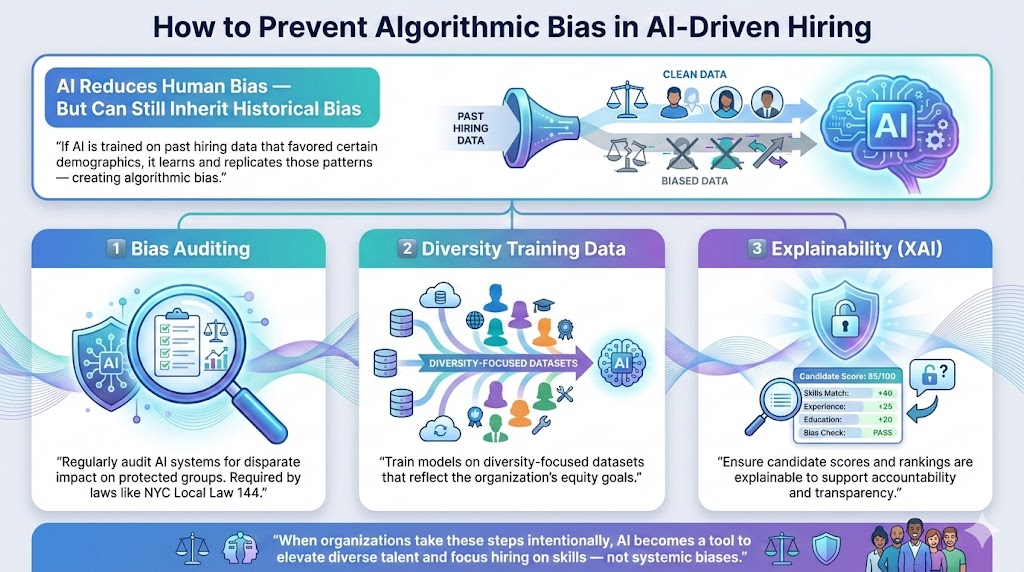
AI has the capability to minimize human bias, however, there is also the potential for the creation of algorithmic bias. Suppose an AI model is trained to predict candidate success based solely on historical hiring data, which has been biased toward a certain demographic. In that case, the model will learn and continue to perpetuate that bias, hence creating a fairer outcome than the hiring process itself but still flawed in that the bias has not been addressed.
In order to resolve the problem of algorithmic bias, organisations must be aware of the necessity for the following:
- BIAS AUDITING: The regular auditing of Al systems for disparate impact to protected classes, as required by existing regulations, such as NYC’s Local Law 144.
- DIVERSITY TRAINING DATA: The organisation must utilise diversity-based training data and train the Al model with such datasets in order to accurately reflect the diversity goals of the organisation.
- EXPLAINABILITY (XAI): The organisation must develop methods for a candidate’s score or ranking to be made known in order to have an approach toward candidates that includes accountability and transparency.
When organisations meet the above challenges with intention, then Al provides an opportunity to purposefully identify and elevate diverse talent through the focus on skills, by removing all the factors that have contributed to the systemic inequality historically.
LinkedIn Profile Scraper - Profile Data
Discover everything you need to know about LinkedIn Profile Scraper , including its features, benefits, and the different options available to help you extract valuable professional data efficiently.
How AI Enhances Employer Branding and Candidate Engagement
Employer Branding is vital today when you consider how competitive it has become with so many companies fighting over candidates. In addition, candidates spend a lot of time doing research on companies before they apply for a job.
AI and Automated solutions help to enhance Employer Branding in a completely different way than what one would expect.
Automation allows hiring companies to eliminate all administrative functions associated with hiring so that every candidate gets personalized communication regardless of whether or not they pass the initial screening process. automated responses (quick and personalized) to candidates signifies the hiring company’s respect for candidates and their time.
AI provides insights into what type of job descriptions, recruiting messages, and career site content produce the highest engagement rates for each candidate segment. this way, the employer branding team can continuously optimize the employer branding message for each segment to have maximum impact.
Hyper-personalization and engagement at scale is not possible without intelligent automation!
The Role of Machine Learning in Talent Forecasting and Workforce Planning
Strategic workforce planning, which entails predicting future talent requirements informed by the business strategy, changes in the market and new technologies, has traditionally been a difficult process, but now it can be done with more accuracy than before thanks to machine learning (ML).
ML analysis utilizes both external and internal datasets ranging from predicted rates of business growth, to levels of employee attrition, to the skills that are emerging in the industry, as well as the hiring behaviours of competitors, to identify potential future talent gaps.
For example, by assessing the rate at which a particular skill is becoming obsolete in the job market and correlating this with the internal forecast of new product development, an ML model can make a very precise prediction about the number of software engineers with specific expertise (like a niche programming language such as Rust or Go) that will be needed three years from now.
This type of predictive analysis will likely become critical for the future of technical recruitment, where the rapid pace of technological advancement will likely render traditional recruiting cycles obsolete. As a result, HR departments will be able to transition from simply filling positions as they become available to proactively building the required skillsets needed to compete in the future.
From Automation to Autonomy: The Impact of Agentic AI in Talent Acquisition
Agentic AI represents the next major shift and evolution in the current conversation surrounding artificial intelligence and its use for automation (speeding up the completion of repetitive tasks).
Unlike the traditional concept of an AI as a tool, Agentic AI’s purpose is to serve as an independently functioning entity capable of perceiving, evaluating, deciding, and executing a course of action toward the accomplishment of a predetermined objective with little or no need for outside influence from human beings.
For example, in the context of recruiting, an AI Agent could be assigned a high-level objective such as, “By the end of Q4, hire a minimum of 10 Senior Full Stack Developers.” The AI Agent could complete every aspect of the recruiting process without any assistance from humans, including:
creating the job description, posting the job description on multiple platforms for various audiences, identifying potential candidates who are not actively looking for jobs (passive), sending personalized messages to those potential candidates, conducting the initial chat screening, scheduling first-round interviews, and finally, after evaluating the responses and outcomes from interviews that occurred as a result of the initial outreach, modifying its own sourcing plan by determining which channels were most effective.
The introduction of Agentic AIs will allow recruiters to maximize their productivity dramatically and will give recruiters the means to scale their recruitment efforts in ways that have never been possible before; effectively creating a self-driving talent recruiting machine!
Read More: What is LinkedIn Crawler?
Ethical and Legal Implications of Automated Hiring Systems
AI is becoming more common in our lives; therefore, our world is now dealing with a greater variety of complex ethical/legal issues arising from how it interacts with society. There are many drawbacks associated with AI being misused, including but not limited to:
The potential for incurring costly fines/regulatory penalties, filing expensive lawsuits and suffering severe damage to one’s reputation due to the misuse of AI. Although many factors contribute to legal considerations surrounding the use of AI, three primary ones can be categorized into three areas:
- data privacy regulations (including GDPR and CCPA)
- transparency related to the use of AI
- compliance with anti-discrimination laws
For instance, New York City passed Local Law 144, which requires independent auditing for bias in the development of automated employment decisions/AI tools and serves as an example for other jurisdictions to follow regarding how bias is developed in AI systems.
The ethical obligation to ensure compliance with anti-discrimination laws extends beyond just regulatory compliance; therefore, we need to create space for human intervention during the entire hiring process. The use of a “human-lens” approach to critical hiring decisions is necessary to build trust with candidates and to create ethical rules regarding the use of AI. In addition to providing an ethical basis for the responsible implementation of AI, a foundation for sustainable AI adoption must include adequate governance mechanisms.
The Road Ahead: What the Future of AI-Driven Talent Acquisition Looks Like
As stated by the Society for Human Resource Management (SHRM), the future of recruiting will be more integrated and sophisticated. We’re moving towards an applicant tracking system (ATS) becoming a true talent intelligence platform, which is essentially a central nervous system that connects labor market data, internal performance metrics and candidates’ engagement history for a comprehensive understanding of how talent is supplied and demanded.
The future of AI recruiting is expected to provide hyper-personalization at scale by allowing each candidate to have a unique application and interview experience. Candidates will be guided through the application and interview process based on their capabilities and background, using AI systems to personalize their experience. Not only will this allow for a better hiring decision, but it also provides a better applicant experience.
Additionally, immersive assessment tools like virtual reality (VR) are anticipated to be utilised in the future to assess candidates for complex or physical roles. This will give hiring managers more data about candidates when making a hiring decision and will also enhance the applicant experience.
Ultimately, AI will not only be a tool for saving costs but also be used to build an incredibly skilled, diverse and prepared workforce for the future.
AI & automation are changing the future of acquiring talent & it’s not going to be something that will happen far in the future; it’s happening now. By utilizing Recruitment Automation Tools, our focus has shifted from doing the mundane tasks of recruiting to using predictive analytics to make strategic decisions about workforce planning.
So, how does it all work? Companies who embrace these technologies will see greater efficiency, objectivity, and strategic advantage over those who do not embrace it as part of their business strategy. Even if we have some challenges with respect to algorithmic bias or ethical issues, a commitment to transparency & human oversight will allow us to utilize this technology in a way that empowers us not just to hire faster but also to hire better, building stronger organizations & offering fairer opportunities for all.
FAQs for the Future of Recruiting
1. Will AI replace human recruiters entirely?
No. AI is designed to automate transactional tasks (screening, scheduling, data entry) and augment human decision-making with data. High-value, high-empathy tasks such as relationship building, complex negotiation, cultural assessment, and strategic advising will remain firmly in the hands of the human recruiter.
2. How can companies ensure AI hiring tools are not biased?
Companies must adopt three key practices:
Bias Auditing: Routinely testing the AI’s outcomes for disparate impact on protected groups.
Data Quality: Training algorithms on diverse, non-biased data sets that reflect fairness goals.
Explainability: Using AI tools that provide transparency regarding how a decision or ranking was reached.
3. What is the primary benefit of using an AI Resume Parser?
The primary benefit is transforming unstructured data (various resume formats) into standardized, structured, and machine-readable data fields. This eliminates manual data entry errors, accelerates the initial screening process, and ensures clean data integration into the Applicant Tracking System (ATS) for further analysis.
4. Is it ethical to use AI to scrape public data like a Linkedin Profile Scraper?
The ethics and legality of data scraping depend entirely on the platform’s terms of service and regional data privacy laws (like GDPR and CCPA). While data extraction tools are widely used for market research, organizations must ensure they are using public data ethically, transparently, and in strict compliance with all applicable legal frameworks regarding data collection and usage.